UPVC Door Repairs Near Me - What to Check
Updated: 2 days ago
A UPVC door rarely gives up all at once. More often, it starts with small signs - the handle feels loose, the key turns stiffly, the door drops slightly, or you have to lift it to lock it. When people search for upvc door repairs near me, it is usually because one of those minor faults has suddenly become a proper problem and the door will not lock, open, or secure as it should.
That matters more than most people think. A faulty UPVC door is not just inconvenient. It can leave your home vulnerable, stop you getting out quickly, or turn a simple errand into an emergency lockout. If the issue is caught early, many faults can be repaired on the spot without replacing the whole door. If it is left too long, what started as a misaligned mechanism can damage the gearbox, strip the handle spindle, or wear out the locking points.
Why UPVC doors fail in the first place
UPVC doors have moving parts packed into a fairly slim frame. There is the multi-point locking strip, the central gearbox, the euro cylinder, the handles, hinges and keeps. If one part starts sitting out of line, the rest of the mechanism has to work harder.
That is why the same few causes come up again and again. Doors drop slightly over time, especially on busy entrance doors. Heat and cold can affect alignment. Older mechanisms wear internally. Cheap replacement parts fitted in the past can fail early. Sometimes the problem is the lock itself, and sometimes it is actually the door, frame or hinges putting pressure on the lock.
This is also where honest diagnosis matters. Not every stiff lock needs a full replacement, and not every jammed door can be solved with a new cylinder. It depends on what has actually failed.
Common problems behind upvc door repairs near me
A lot of customers assume a broken UPVC door means the whole unit needs changing. In reality, many issues are repair jobs rather than replacement jobs.
The door will not lock properly
This is one of the most common faults. You close the door, lift the handle, and it either resists or will not engage the locking points fully. In some cases the key will not turn because the mechanism is under strain.
Often, this points to alignment problems. The door may have dropped, hinges may need adjustment, or the keeps may no longer line up cleanly with the locking points. If dealt with early, this is usually repairable without major parts.
The handle has gone floppy or stopped working
A loose or floppy handle can mean the spring cassette has failed, the spindle is worn, or the internal gearbox is damaged. Sometimes the handle itself is the only failed part. Sometimes it is the first visible sign that the lock case is wearing out.
The difference matters because replacing a handle alone will not solve an internal gearbox fault.
The key turns but nothing happens
This is a classic sign of internal lock failure. The cylinder may still turn, but the central mechanism is not retracting the latch or operating the multi-point strip properly. If the door is shut when this happens, it can become a more involved opening job before repairs even begin.
The door is stuck shut or stuck locked
This is the sort of job people need sorted fast. A UPVC door stuck shut can leave you trapped in or out, and forcing it usually makes things worse. Specialist opening is often needed here, followed by repair or replacement of the failed part.
The lock works, but the door catches on the frame
That usually points to hinges, alignment, wear in the frame, or movement in the door over time. Left alone, the extra strain can damage the lock mechanism.
What can usually be repaired on the first visit
A properly equipped locksmith can deal with a wide range of UPVC door faults without needing to board things up and come back days later. That is especially important when the door is your main entrance.
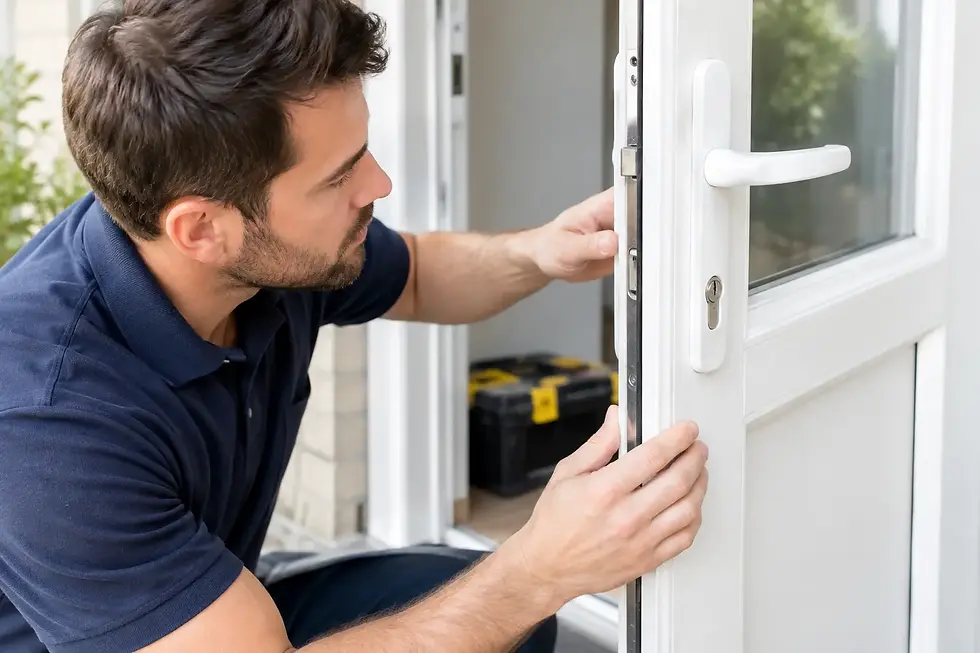
Many first-visit repairs involve replacing failed cylinders, handles, gearboxes, full multi-point mechanisms, keeps and hinge components. Adjustments can often be made there and then to correct a dropped or misaligned door. If there is damage around the frame or door edge, some jobs also need carpentry or reinforcement work rather than just lock work.
This is why experience with UPVC systems matters. These doors are not all built the same. Different manufacturers use different backsets, spindle centres, faceplate dimensions and mechanism types. Getting the right fit matters. A rushed or guesswork repair can leave the door locking badly again within weeks.
When repair is better than replacement
A lot of people worry they are heading for the cost of a full new door. Sometimes that is necessary, especially if the panel, frame or structure is badly damaged. But in many cases, repair is the better route.
If the issue is with the cylinder, gearbox, locking strip, handle or alignment, there is often no reason to replace the entire door. A good repair restores security, improves operation and costs far less than a new installation.
Where it becomes more of a judgement call is with older doors that have several worn parts at once. If the mechanism is obsolete, the hinges are tired, and the frame has movement, the repair may still be possible but not always the most economical long term. A straight answer matters here. You want to know whether the fix is likely to last, not just whether it can technically be done today.
Choosing a local locksmith for UPVC door repairs
If you are searching for a local repair service, speed matters, but so does capability. A lot of general trades can swap a lock barrel. Fewer can properly open, diagnose and repair a failed UPVC door mechanism without causing extra damage.
Look for someone who deals with specialist door and window locking systems regularly, not as an occasional add-on. Ask whether they carry common UPVC parts, whether they handle jammed doors, and whether they can adjust hinges and alignment as part of the job. If the answer to everything is "we'll have a look", that is not always reassuring.
A local family-run locksmith service tends to be better placed for this sort of work than a national call centre model. You are more likely to speak to someone who understands the job, gives you a straight idea of what may be involved, and turns up focused on getting the door working properly rather than pushing a bigger sale.
Clapham Locksmiths handles this sort of problem every week, and that practical experience makes a difference when the fault is not obvious at first glance.
A few checks before you call
If the door is partly working, there are one or two useful things to notice before the locksmith arrives. Do not force the handle or keep wrenching the key, but check whether the problem happens only when the door is closed or also when it is open. If it works open but not shut, alignment is likely involved. If the handle is completely slack in both positions, the issue may be internal.
Also notice whether the key is hard to turn in the cylinder itself, or whether the resistance only comes when lifting the handle. That helps point to whether the cylinder or mechanism is the main fault.
If the door is fully stuck shut, the best thing you can do is stop trying to force it. The extra pressure can turn a repairable mechanism into a more expensive opening and replacement job.
What a good repair visit should feel like
It should be straightforward. The locksmith should inspect the door, explain what has failed in plain English, and tell you whether the issue is a repair, a replacement part, or a broader alignment problem. If there are options, you should be given them clearly.
The repair itself should leave the door locking smoothly, not just technically working. That means checking handle action, key operation, latch movement and alignment across the whole frame. A proper job is about getting the door secure and reliable again, not just making the immediate symptom disappear.
That is especially important for landlords and small businesses. A quick fix that fails again means another callout, more disruption, and in some cases a security risk for tenants, staff or stock.
Fast action usually saves money
The earlier a UPVC door fault is looked at, the more chance there is of keeping the repair simple. A slightly dropped door can often be adjusted. A struggling mechanism caught early may only need one component. Once parts start grinding against each other, the repair tends to grow.
So if your handle is getting stiff, the key is starting to drag, or the door only locks if you lift and shove it just right, do not wait for the day it jams completely. Local UPVC door repairs are usually quickest, cheapest and least stressful when the problem is dealt with before it becomes an emergency.
A door should shut properly, lock properly and feel secure every time you use it. If it does not, that is reason enough to get it sorted.
Comments