
A Door Reinforcement Guide for Homeowners
A good lock can still be beaten by a weak frame, loose hinges or a door that no longer sits properly in the opening. That is why a door reinforcement guide for homeowners needs to look beyond the keyhole. The aim is not to make your front door look like a bank vault. It is to make forced entry slower, noisier and far less likely to succeed.
For most homes, the best improvements are practical ones: a correctly fitted lock, solid fixings into sound timber or masonry, and a door that closes and locks without force. Start by looking at the whole door assembly, then deal with the weak point rather than buying security products at random.
Start with the door, frame and fit
Open the door and check for movement at the hinges, lock edge and frame. A little normal movement is one thing. A door that rattles, drops when opened, catches on the threshold or needs lifting to lock is another. Poor alignment puts strain on locks and means bolts may not fully engage with their keeps.
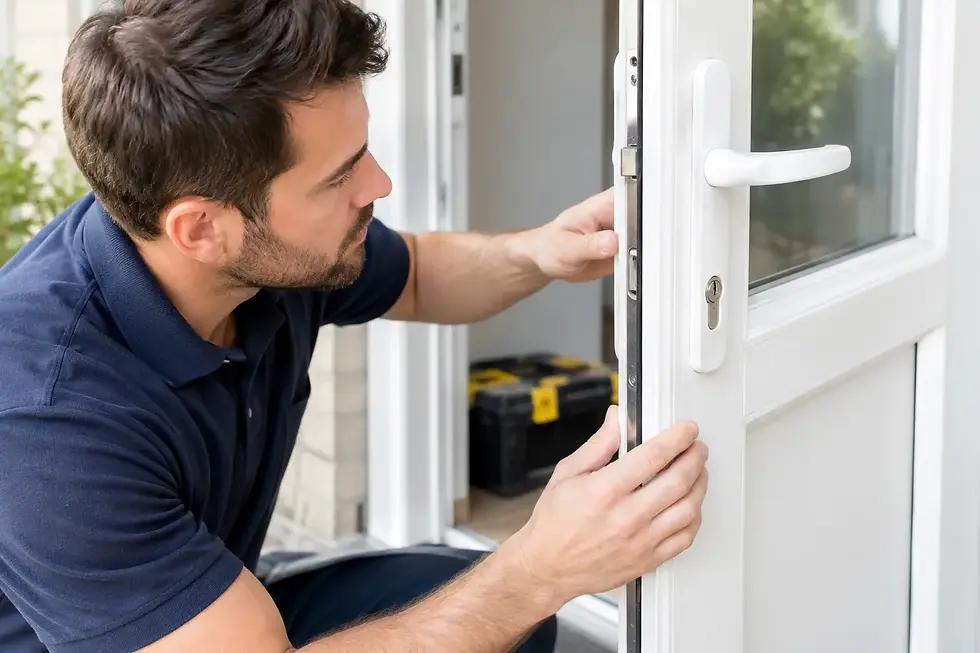
Look closely at the frame around the lock. On timber doors, splits around the strike plate, old screw holes and soft or decayed wood all reduce the strength of the fixing. On UPVC and composite doors, examine the keeps, the door edge and the frame for cracks, distortion or loose screws. A multi-point lock can be in good condition but still provide poor protection if its hooks, rollers or bolts do not line up properly.
The door itself matters too. A thin, damaged or warped timber door may not justify expensive lock upgrades until the door or damaged sections are repaired. With an older front door, a carpenter and locksmith may need to work together to make the door, frame and lock operate properly.
Reinforce the lock side first
The lock side is often the first area to assess because it takes the force of an attempted kick or shoulder. A standard strike plate held by short screws only grips the frame lining, not the structural timber behind it. Replacing it with a heavy-duty security keep or strike plate, fixed with long screws into solid timber, can make a real difference.
This is not a job for the longest screw you can find in a drawer. Screws must suit the frame and fixing surface. Screwing into a hollow section, damaged timber or brickwork without the right plugs will not provide the support you expect. If the frame is split, reinforcing over the damage alone is rarely a lasting repair.
For doors with a mortice lock, check that the bolt throws fully into the keep when locked. For nightlatches, look at the rim cylinder, the internal fixing and the strength of the keep on the frame. Many timber front doors have both a mortice deadlock and a nightlatch. That can work well, provided both are fitted correctly and you are not creating a complicated locking routine that people stop using.
Choose the right lock upgrade
The right lock depends on your door type and your insurer's requirements. A timber front door may suit a British Standard mortice deadlock, while a UPVC or composite door commonly uses a euro cylinder within a multi-point locking mechanism. Where a euro cylinder projects from the handle, an anti-snap cylinder and suitable security handles are often worth considering.
Do not fit a new cylinder simply because it has a higher security rating if the door is badly aligned. Forcing a stiff multi-point mechanism can damage the gearbox and leave you locked out. The door should lift, close and lock smoothly before any final adjustment is made.
Do not overlook hinges and the hinge side
If your door opens outwards, exposed hinges need particular attention. Hinge bolts or security studs can help stop the door being lifted from its hinges if the hinge pins are attacked. They should be fitted accurately so the door closes cleanly and the studs engage with their matching holes.
For inward-opening doors, hinges are less exposed but still deserve a check. Loose screws, worn hinge knuckles and a dropping door can affect the lock side as much as the hinge side. Longer screws may help on a sound timber frame, but they are not a cure for stripped holes or rotten wood.
UPVC, composite and aluminium doors use different hinge systems, and adjustment is often more involved than it looks. Incorrect adjustment can leave a door catching, draughty or unable to engage its locking points. If the door has suddenly dropped or become difficult to lock, deal with it promptly rather than forcing the handle.
A practical door reinforcement guide for homeowners
Work through these checks before deciding what to repair or upgrade:
Test the door with the handle lifted or the deadlock thrown. The bolts should engage without needing to push, pull or lift the door hard.
Inspect the lock keep, strike plate and surrounding frame for cracked timber, loose fixings, rust or movement.
Check that hinges are tight, the door has not dropped and any exposed hinge side has suitable protection.
Examine cylinder and handle fittings for excessive projection, looseness or signs of attempted damage.
Make sure keys are accounted for after moving home, changing tenants or losing a set. Changing a cylinder can be quicker and more sensible than wondering who still has access.
Security is about layers, not one item. A strong lock paired with a weak frame is a compromise. Equally, a reinforced frame will not help much if a worn cylinder can be manipulated or the door is routinely left on the latch.
Door type changes the job
Timber doors are usually straightforward to reinforce, but only when the timber is sound. A security keep, longer structural fixings and a correctly fitted mortice lock can be effective. If there is rot around the lock area or the frame has started to split, repair work should come first.
UPVC and composite doors need a different approach. Their strength comes from the full system: hinges, keeps, multi-point mechanism, handles, cylinder and door alignment. Replacing a cylinder may improve resistance to snapping, but it will not fix a failed gearbox, worn keeps or a bowed frame. Specialist adjustment and repair can often save a door that appears to need replacing.
Bifold doors deserve separate attention. Their locks, shoot bolts, hinges and track alignment all need to work together. A stiff bifold is not just inconvenient. It can stop locking points from fully engaging. Avoid forcing the handle, as this can turn a straightforward alignment issue into a more expensive mechanism repair.
Avoid the common quick fixes
A few DIY improvements are sensible, but there are limits. Do not pack a loose lock keep with bits of timber, use random oversized screws in a UPVC frame, or fit a lock that leaves the cylinder sticking out far beyond the handle. Those fixes can create fresh weaknesses or make the door unreliable in an emergency.
Be careful with listed properties, shared entrances and fire doors. A communal or fire-rated door may have specific hardware and closing requirements. Changing locks, adding bolts or altering the frame without checking can affect fire safety, building management rules or your tenancy agreement. Landlords should also make sure any upgrade still allows a safe means of escape where required.
Visible security can help, but it should not advertise panic. A properly repaired frame, a good cylinder and a door that locks cleanly are often more valuable than a collection of add-on devices. If you have had an attempted break-in, photograph the damage before repairs and speak to your insurer where appropriate.
When to call a locksmith
Call for help if the lock feels rough, the handle will not lift, the key turns without locking, the door is visibly misaligned or the frame is cracked after an attempted burglary. These are signs that need a proper inspection, not more force. A local locksmith can assess the lock, frame and door together, explain the sensible options and carry out repairs without unnecessary replacements.
For homeowners in Clapham and nearby areas, Clapham Locksmiths can deal with lock upgrades, burglary repairs, UPVC door alignment and reinforcement work in one visit where possible. The useful question is not simply, “What is the strongest lock?” It is, “What is the weakest part of this door?” Fix that properly, and you will sleep more easily tonight.
Comments