
Best Burglary Resistant Door Upgrades for Homes
A burglar does not need to defeat every part of a door. They only need to find the weakest one - often an old cylinder, loose strike plate, split frame or poorly fitted letterbox. The best burglary resistant door upgrades deal with the whole door set, not just the lock in the middle. That is how you make forced entry slower, noisier and far less worthwhile.
For a flat, house or small business premises, the right work depends on the door material, the existing lock arrangement and how the door closes into its frame. A good upgrade should improve security without leaving you with a stiff door, unreliable multipoint lock or an expensive replacement that was not needed.
Start with the lock that suits the door
The lock is usually the first thing people think about after a break-in, and for good reason. But there is no single lock that suits every front door.
On a timber door with a mortice lock, a British Standard 3621 five-lever mortice deadlock is often a sensible security upgrade. This type of lock is commonly requested by insurers and gives a stronger level of resistance than an older basic mortice lock. It needs to be fitted accurately, though. Cutting a large pocket into an already weak or damaged timber door can create another problem if the surrounding wood is not repaired and reinforced properly.
On UPVC and composite doors, the most vulnerable component is often the euro cylinder. Older cylinders can be susceptible to snapping or forced removal. A high-security anti-snap cylinder, ideally one independently tested to recognised standards such as TS007 3-star or SS312 Diamond, can make a major difference. These cylinders are designed so that, if attacked, the outer section breaks in a controlled way while the internal locking mechanism remains protected.
The key point is compatibility. A cylinder must be the correct length for the door and handle furniture. If it sticks out too far, it gives an intruder more to grip. If it sits too far inside, it can be awkward to use and may not work with the handle as intended. A properly measured and fitted cylinder is safer than simply buying the most expensive one on the shelf.
Check the multipoint lock before changing the cylinder
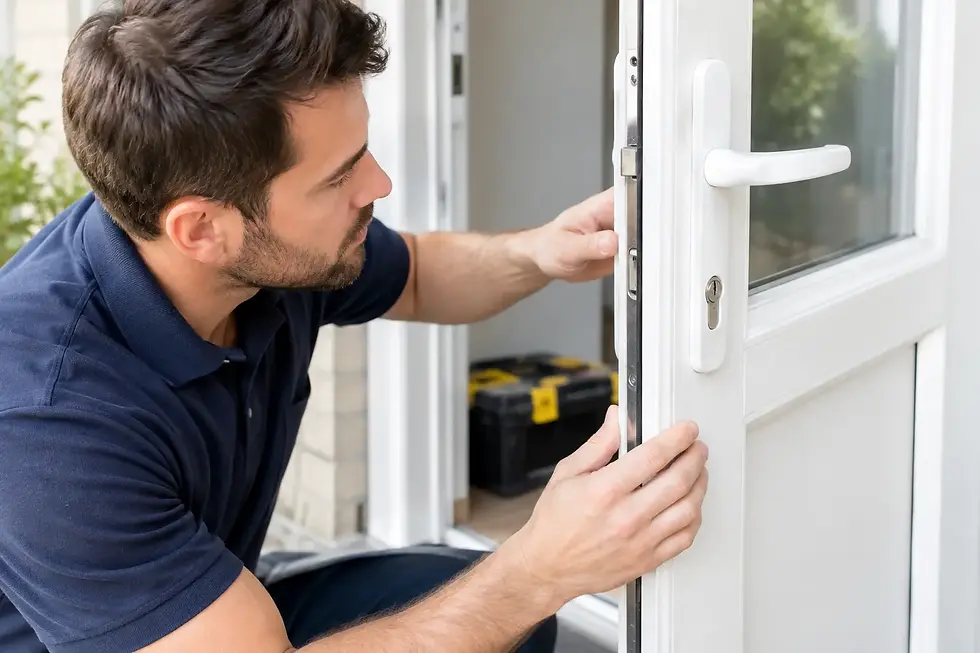
Many UPVC, composite and bifold doors use multipoint locking systems. These lock at several points along the edge of the door when the handle is lifted and the key turned. If the mechanism is worn, the door has dropped, or the keeps in the frame are misaligned, fitting a new cylinder alone will not solve the underlying fault.
Warning signs include a handle that needs lifting hard, hooks or bolts that do not engage cleanly, or a key that only turns when you pull the door towards you. These issues should be dealt with early. Forcing a stiff mechanism can lead to a complete lock failure, leaving the property unsecured or locking you out.
Reinforce the frame and strike side
A strong lock is only as useful as the timber, metal or masonry holding it. On many forced-entry jobs, the lock has stayed intact while the frame split around the keep or strike plate.
For timber doors, reinforcing the strike side with longer, correctly positioned screws can help, provided they bite into solid structural timber rather than thin trim. Security strike plates and frame reinforcement products can spread the force of an attack across a wider section of the frame. If the frame is cracked, rotten or previously repaired badly, reinforcement alone may not be enough. The damaged area needs proper carpentry work first.
A London bar can be a practical option on certain outward-opening or timber doors. It is a metal bar fitted over the frame around the lock area to protect against levering and frame splitting. It is visible, which some homeowners like as a deterrent, while others prefer a less noticeable repair. The right choice depends on the door layout and whether there is enough sound timber to fix into.
For communal entrances and shop doors, the frame condition matters just as much. Repeated slamming, poor alignment and old repairs can loosen keeps over time. A locksmith who can also assess door and frame carpentry can identify whether the problem is the lock, the frame, or both.
Do not overlook hinges and the hinge side
If a door opens outwards, exposed hinges need attention. Standard hinges with removable pins can be an easy target if there are no hinge bolts or security studs. Hinge bolts fit into the edge of the door and engage with sockets in the frame when the door is shut. If the hinges are attacked, the bolts help keep the door in place.
On UPVC and composite doors, check that hinges are secure, adjusted correctly and not allowing the door to sag. A dropped door can stop the locking points from engaging fully. It may still look locked from outside, but it is not providing the protection it should.
This is one reason the best burglary resistant door upgrades are often a mix of hardware and adjustment. A door should shut firmly, line up cleanly and lock without excessive force.
Protect the cylinder and handle area
A quality cylinder is more effective when paired with appropriate security handle furniture. On compatible UPVC and composite doors, a security handle with a reinforced backplate can reduce access to the cylinder and make snapping attacks harder.
Not every door needs a new handle. If the existing handles are solid, correctly fitted and protect the cylinder well, changing the cylinder may be enough. But where handles are loose, thin, damaged or leave the cylinder exposed, replacing both parts makes sense.
Be wary of decorative handles that look substantial but offer little protection. Security hardware should be chosen for the door type and locking system, not just its finish. Satin chrome, brass and black furniture can all look smart, but the fitting and the security rating matter more than the colour.
Secure letterboxes, glazing and nearby windows
A letterbox can create a direct route to the internal thumbturn, keys or handle. This is known as letterbox fishing. If keys are regularly left on a hall table within reach, or the internal lock can be operated through the opening, consider a letterbox guard or cage. The guard must be fitted so it does not obstruct safe exit in an emergency.
Glazed panels beside or within a door need an honest assessment too. Toughened or laminated security glass is harder to break than ordinary glazing, but changing glass is not always the first job. If the pane gives access to an internal thumbturn or handle, changing the locking arrangement, fitting a guard, or moving keys out of reach may offer a better balance of cost and security.
Ground-floor windows close to the front or back door also deserve attention. There is little value in strengthening one entrance while leaving an easily forced window beside it. Locking handles, sash jammers and repairs to faulty UPVC window mechanisms can close off that weakness.
Choose upgrades after a burglary with care
After a break-in, it is tempting to replace everything immediately. Some doors do need replacement, particularly where the slab, frame or multipoint system has been badly damaged. More often, targeted repairs are the better answer: secure the property first, repair the frame, renew damaged keeps or hinges, then fit a suitable lock upgrade.
Avoid fitting temporary surface bolts or cheap hasps as a permanent answer to a damaged front door. They may offer short-term reassurance, but can interfere with the door operation, fail under force or create a fire-safety concern. A proper repair should leave the door secure and usable every day.
For landlords, matching key control across a property can also be worthwhile. When a tenancy changes, cylinders can be replaced or rekeyed where suitable, so old keys no longer work. It is a straightforward step that is often missed after a tenant moves out.
When a security inspection is worth arranging
If your door is difficult to lock, the key turns inconsistently, the frame is split, or there are visible marks around the cylinder, do not wait for it to fail completely. Small alignment and fitting faults can turn into an emergency callout at the worst time.
For properties in Clapham and surrounding areas, Clapham Locksmiths can assess locks, UPVC mechanisms, bifold door systems, hinges, frames and window security on site. The useful outcome is not a long list of expensive products. It is a clear explanation of what is weak, what needs repairing now and what upgrade will genuinely improve the door.
A well-secured door should feel ordinary to use: it closes cleanly, locks without a fight and gives you no reason to think twice when you leave. That is usually the sign that the work has been done properly.
Comments