How to Fix a Jammed Lock Safely
A jammed lock always seems to happen at the worst moment - when you are heading out, closing up for the night, or standing outside in the rain with shopping bags in hand. If you are wondering how to fix jammed lock problems without making things worse, the first thing to know is this: forcing it is usually what turns a repair into a replacement.
Some jams are simple. A dry cylinder, a worn key, a swollen wooden door, or a slightly dropped UPVC door can all stop a lock from turning properly. Others are a sign that something inside the mechanism has broken or shifted. The trick is knowing which sort of problem you are dealing with before you lean harder on the key and snap it clean off.
How to fix jammed lock problems without causing damage
Start with the basics. Put the key in fully and check whether it goes all the way into the lock. If it stops short, look inside the keyway with a torch. Dirt, a small bit of debris, or damage around the opening can stop the key seating correctly. Do not poke around with anything that can break off inside.
If the key goes in but will not turn, ease off and check the door itself. Many lock problems are really door alignment problems. A door that has dropped by a few millimetres can put pressure on the latch or deadbolt, making the lock feel jammed when the mechanism is actually fine.
Try gently pulling the door towards you, then pushing it in slightly as you turn the key. If the lock works in one of those positions, the issue is likely alignment rather than the cylinder. That matters, because lubricating or replacing the lock will not fix a door that is out of line.
A little patience helps here. Quick force rarely does.
Check the key before blaming the lock
Keys wear down over time. If you use the same front door key every day, the cuts can become rounded, especially on older brass keys. A worn key may still slide in but fail to move the pins properly.
If you have a spare key, try that next. If the spare works smoothly, the problem is probably the key rather than the lock. That is the better outcome. A fresh cut key is a much cheaper fix than a new lock case or euro cylinder.
Also look for bends, cracks, or twisting in the key. Even a slight bend can make turning difficult. Do not try to straighten it and carry on using it. That often leads to a snapped key in the lock.
Use the right lubricant
A dry lock can become stiff enough to feel jammed, particularly on older doors, garden gates, and locks exposed to weather. The right product can help. The wrong one can make the problem worse.
Use a graphite-based product or a proper lock lubricant. Avoid thick oil, cooking oil, grease, or anything sticky. Those attract grit and dust, which then builds up inside the mechanism. WD-40 can free things off in the short term, but it is not the best long-term choice inside a cylinder.
Apply a small amount into the keyway, insert the key, and work it in gently. Do not keep turning harder if it still resists. If lubrication does not improve things after a few careful attempts, stop there.
When the jam is really a door problem
A lot of people assume the lock has failed when the real issue is the door or frame. This is especially common with UPVC doors, composite doors, and older timber doors that shift with temperature and moisture.
If the handle lifts but the key will not turn, the multi-point locking system may be under pressure. Try lifting the handle fully, then easing the door towards the frame or pulling it slightly away while turning the key. If that helps, the keeps and rollers may be misaligned.
With wooden doors, swelling is another common cause. After damp weather, the door can bind against the frame and put strain on the latch and lock. You may notice scraping around the edge as well as stiffness in the key. The lock is not exactly jammed in that case, but it feels like it.
For business premises, shutters and rear access doors can also shift over time. If the lock only plays up when the door is shut, alignment is high on the list of likely causes.
UPVC and multi-point locks need more care
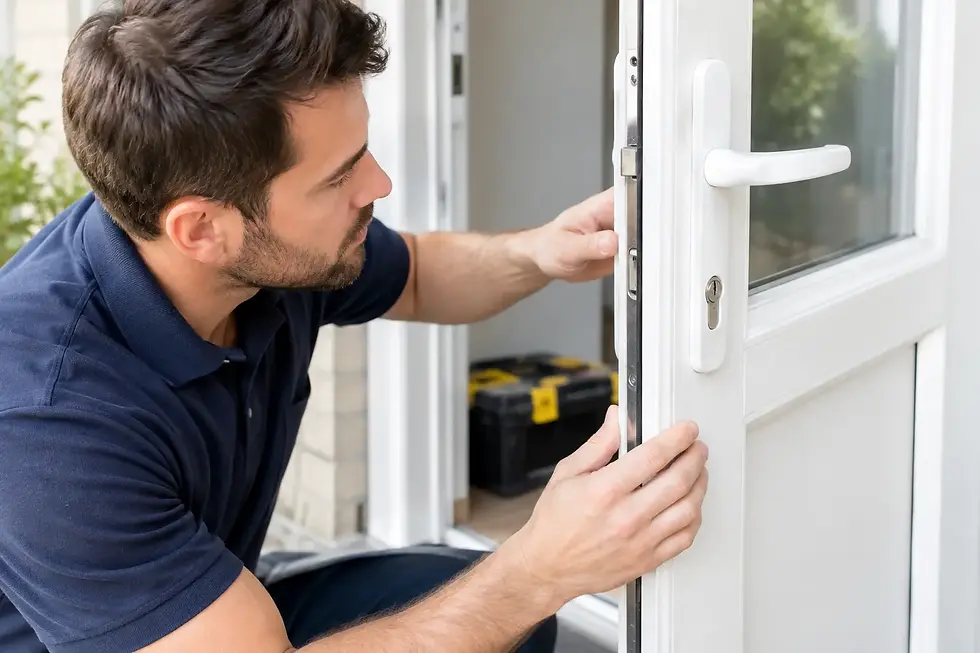
If you have a UPVC door, be careful. These mechanisms are more complex than a simple Yale or mortice lock. A jam can come from the euro cylinder, gearbox, handle spindle, or internal strip mechanism.
If the key will not turn and the handle feels floppy or unusually stiff, there may be an internal fault. Keep forcing it and you can turn a single failed part into a full mechanism repair. On some doors, that means a more awkward and more expensive job.
This is one of those situations where it depends. If the problem is mild stiffness and the door still opens, checking alignment and using a proper lubricant may sort it. If the door is shut and fully jammed, or the key is at risk of snapping, professional help is usually the safer option.
What not to do when a lock is jammed
Most lock damage we see has been made worse by panic. That is understandable, but a few common mistakes cause trouble very quickly.
Do not force the key with pliers. Do not kick the door. Do not spray random household products into the lock. And do not take the lock apart unless you know exactly what type of mechanism you are dealing with.
Cylinder locks, mortice locks, night latches, and multi-point systems all behave differently. What works on one can ruin another. Even removing a handle or cylinder at the wrong stage can leave you with a shut door that is harder to open than before.
If the key is turning only part way, that is a warning sign. Likewise if the handle lifts but drops without resistance, or if the key gets stuck on the way out. Those are often signs of an internal failure rather than a simple dry lock.
How to fix jammed lock issues you can safely handle
There are a few sensible checks you can do yourself before calling anyone out. Try a spare key. Relieve pressure on the door by pushing or pulling it slightly. Inspect the keyway for visible dirt. Use a proper lock lubricant sparingly. On a stiff timber door, see whether the issue changes when the door is open versus shut.
If the lock works with the door open but jams when closed, the problem is usually alignment. If it jams in both positions, the fault is more likely inside the lock itself. That small test tells you a lot.
For a household with children, tenants, or staff coming and going, it is also worth asking whether anyone noticed the lock getting stiff over the last few days. Locks rarely go from perfect to seized with no warning at all. A gradual change often points to wear, poor alignment, or a part starting to fail.
When to call a locksmith
If the key will not go in fully, will not come out, or feels close to snapping, stop. If the door is locked shut and you cannot secure or access the property properly, stop. If it is a UPVC multi-point system, a communal entrance, a shop front, or a lock that has already been forced once, stop there as well.
That is where an experienced locksmith earns their keep. A proper diagnosis saves time and often saves hardware too. In many cases, the fix is not a full replacement. It might be a cylinder change, a gearbox repair, a realignment, or adjustment to the frame and keeps. The main thing is dealing with the actual fault rather than guessing.
For local homes and businesses in Clapham, quick attendance matters because a jammed lock is rarely just an inconvenience. It can leave a property insecure, trap someone inside, or stop you opening up for the day. A locksmith with stocked parts and experience across standard locks, UPVC doors, and specialist mechanisms can usually sort the problem in one visit.
Clapham Locksmiths deals with this sort of job every day, and that practical experience matters more than theory when a door simply needs opening and fixing properly.
Sometimes the best result is a small repair done early. Leave it too long and a stiff lock becomes a failed lock, then a damaged door, then a bigger bill than anyone wanted. If you take one thing from this, let it be this: treat resistance in a lock as a warning, not a challenge.
Comments